Freethought Nation

presented by Acharya S and Truth Be Known, online since 1995

A Pre-Christian 'God' on a Cross?

E-mail Print PDF

While I am moving closer to the publication of my Moses book, I could use some assistance, so I'm offering a brand-new, 40-page ebook entitled, "A Pre-Christian 'God' on a Cross? My paper examines a famous artifact of a crucifix with the inscription "Orpheos Bakkikos."

A Pre-Christian 'God' on a Cross?

  • Contains over 40 images illustrating the main themes
  • Includes numerous primary sources, often with original text in Greek and Latin
  • Provides 119 footnotes and annotated citations
  • Includes a bibliography with some of the latest research
  • Contains an extensive table of contents with many subsections, for ease of reference
  • Includes image captions for the visually impaired

You may know that the artifact examined in this ebook has been assailed as a "forgery," but is that assessment truly scientific? Or is it a rush to judgment and hasty conclusion based on bias and oversight?

For more information, including a table of contents, please see:

A Pre-Christian 'God' on a Cross?

http://stellarhousepublishing.com/prechristiancrucifix.html

I am offering this 40-page ebook to those who get a monthly subscription to my work, for as little as $3. Although I can always use the help, you are free to cancel the subscription at any time and keep the ebook, so there's no "risk." (Requires a Paypal account.)

I hope you enjoy reading my new work, and I truly appreciate your interest and support.

"Yes, I want a copy of A Pre-Christian 'God' on a Cross?"
Monthly Subscription
Last Updated on Friday, 17 May 2013 16:41
 

A leftist answers questions about Islam

E-mail Print PDF

LMAO! Sounds about right.

Islam apologetics typically goes something like this:

1. Denial
2. Deflection
3. Insults
4. Threats
5. Violence

Last Updated on Friday, 10 May 2013 23:27
 

Oldest Maya solar observatory and parallels between Old and New World cultures

E-mail Print PDF

Please see my new Examiner article:

Oldest Maya solar observatory gives rise to new origin theory

This brief article touches upon a fascinating subject that includes as a central feature of the pre-Christian Mayan religion and mythology the cyclical death and resurrection of the solar maize/fertility god. As I say in my article and elsewhere, there are many parallels between Old and New World religion and mythology.

The reasons for the amazing correspondences are complex, but the chances that they derive from pre-Columbian diffusionism are actually slim to none. In my book The Christ Conspiracy, I delve into the idea of a global civilization in antiquity that spread these ideas. However, since the time of publication in 1999, science has made great strides on this question, from the perspective of DNA and disease studies in particular, as well as species migration studies, as with invasive plants and animals.

Because we simply have no hard scientific evidence of any sort of large-scale and sustained diffusionism of "Old World" ideas (or species) to the "New World," after the early migrations across the Bering Land Bridge and before Columbus, most of these parallels must have been developed as part of humankind's natural thought processes. This latter contention is logical, because the human brain in general operates the same way, wherever it may be found, just as do other species, even though they may possess variants. For example, birds and dogs may differ widely in looks and size, beak/muzzle shape, and so on, but they have the same basic body type, instincts and needs. The bottom line is that, if a human being can think of something once in one part of the world, straight "out of the blue," then another human being can have the same thought elsewhere, likewise "out of the blue" and independently.

The Sacred Mountain

Humanity possesses a basic archetype of how it views the world and cosmos, with seemingly unlimited expressions of the same, depending on where and when humans are thriving. Thus, the basic idea of a "sacred mountain" point of origin, where humanity first arose, can be found in many cultures globally, with a variety of portrayals. This sacred mountain idea occurs in peoples in the southern regions of Africa, such as the Pygmies, who claimed that the Mountains of the Moon were the point of human origins, a notion given credence by the fact that the range is one of the sources of the life-giving Nile. Moreover, as we know, some of the oldest hominid remains have been discovered in nearby Tanzania, at Olduvai/Oldupai Gorge.

This sacred-mountain point-of-origin concept may have been carried with humanity as it migrated out of Africa 70,000 years ago (as the current paradigm holds), with various groups localizing the mountain on Earth as they traveled. This theory would explain the numerous sacred mountains in global myths, as well as the terracing or shaping of hills and building of pyramids where no such natural features existed. Or the notion could have developed independently; in either case, the sacred mountain is arguably one of the oldest religious ideas in existence.

DNA and Disease Markers

As concerns pre-Columbian diffusionism, we do not have any disease markers indicating epidemics like those that occurred when the Europeans arrived, wiping out some 90% of the Native Americans. Genetic studies of whether or not there could have been some smaller scale contact and breeding, such as with Japanese sea drifters, seem to be contradictory, as some analyses claim one only migration, while others indicate up to nine. Currently, the mainstream academic paradigm favors the one-migration theory, with no genetic indication of post-Beringian mating between Old and New World peoples.

Yet, some of the religious and mythological parallels between the Old and New Worlds are very detailed, and, although most diffusionist "evidence" has been rebutted, stories of occasional discoveries of Phoenician or Roman artifacts in the Americas continue to intrigue, such that there seems to remain a small portal for limited contact between the two worlds, such as unintentional drifting with the currents.

For the most part, however, the parallels between the Old and New World religions and mythologies exist largely because of the observations of nature worship, such as the cycles of the sun, moon, planets and so on. This basic global archetype founded upon natural observations and insights subsequently was expanded upon with variations explained by the immediate environment, including local topographical features, animals, plants, weather systems and so on.

Harvest/New Year

In this same regard, natural cycles such as spring and fall, corresponding to the time of planting and harvesting, likewise find their way into many myths, with the advent of agriculture. In areas where agriculture is not developed or is limited, these myths would not play as central a role as they do in agricultural regions.

In this regard, in my book Did Moses Exist? I discuss how Israel as a people came to exist when tribal groups adopted agriculture, including the rituals and myths that accompany it, in this case those of the Canaanite/Ugaritic/Northwest Semitic peoples. Thus, the "Feast of the Tabernacles" is a fall harvest ritual, including the time of the vintage and serving as the beginning of the New Year in the arid and warmer region of the Levant. It was at this time that the ancient Levantine peoples expected the "early rains," which signaled the renewal of life.

Vine and Wine

In this same regard, with the spread of grapevine cultivation or viticulture, along with wine-making or viniculture, came the myths of the vine/wine god, later called Dionysus/Bacchus. This vine/wine cult was immensely popular wherever the highly useful grape and wine were cultivated and produced. Grapevine cultivation and wine production have been extremely important and lucrative around the Mediterranean for the past 3,000 to 5,000 years, if not longer. I will also be discussing this subject extensively in Did Moses Exist?, because the Bible is full of references to vines and wine, and the god Dionysus figures prominently in the comparative-religion studies of the Moses myth.

In any event, as we can see, the reason for parallels between disparate and far-flung peoples represents a complicated subject not easily solved by either diffusionism or strict isolationism.

Further Reading

Oldest Maya solar observatory gives rise to new origin theory
Maya watchtowers discovered to align with solstices and equinoxes
Why do the Maya believe Christ is the sun?
Quetzalcoatl, the Maya Maize God, and Jesus Christ
World Tree as Milky Way growing out of the back of a turtle
Adventures in Mayaland, December 2012

Last Updated on Sunday, 28 April 2013 18:07
 

New book about Bart Ehrman and the Christ myth!

E-mail Print PDF

The collaborative rebuttal of Bart Ehrman's book Did Jesus Exist? is now available both in Kindle and hard copy! This one-of-a-kind volume is entitled Bart Erhman and the Quest of the Historical Jesus of Nazareth: An Evaluation of Ehrman's Did Jesus Exist? (Cranford, NJ: American Atheist Press, 2012). The book includes the writings of several mythicists, to wit: me, Frank Zindler, Robert M. Price, Earl Doherty, Rene Salm, Richard Carrier and David Fitzgerald. To my knowledge, this book represents the first time articles of so many Jesus mythicists have been published together in one volume, specifically in defense of Christ-myth studies.

Most of the writing is by Frank Zindler, a past president of American Atheists who has written several mythicist articles and the book The Jesus the Jews Never Knew, among others. The present tome was edited by Zindler and Bob Price, who dedicated it to the great Thomas Paine, himself a student of the case for Jesus mythicism and evidently discussed it with American president Thomas Jefferson.

Contents

The book's contents are divided into five parts, covering Ehrman's tome in the first section, addressing in specific the problem of Nazareth in part 2, with the third part discussing "crucified messiahs," the fourth and fifth parts composed of lengthy articles addressing various other aspects of Jesus mythicism and Ehrman's work.

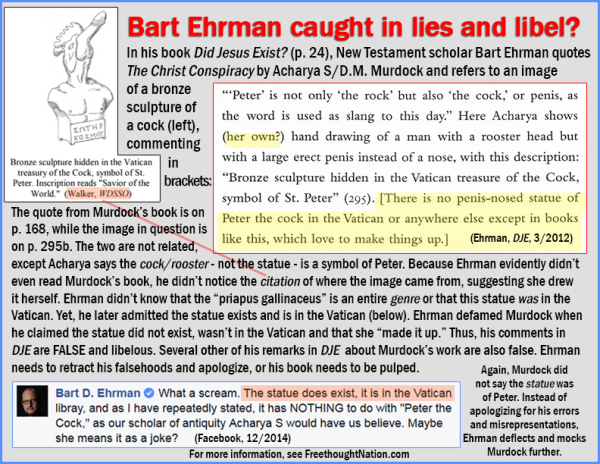
My first essay appears in the initial part, "Ehrman's Arguments Engaged." My paper represents a reprint of my writing at Freethought Nation, "The phallic 'Savior of the World' hidden in the Vatican," which bears reiteration for many reasons, including that the popular god Priapus shares several important characteristics in common with Christ, as I also discuss in a follow-up article entitled, "The phallic 'Savior of the World' at the Vatican revisited."

My other article in the Ehrman rebuttal book appears in section two, "The Problem of Nazareth," in which Zindler and Salm demonstrate that there is no evidence Nazareth existed as a "city" or inhabited place during the era when Jesus purportedly lived. My article in this part is entitled, "Was There a Historical 'Jesus of Nazareth?' The use of Midrash to create a biographical detail in the gospel story." In this paper, I show that there is no reason to assume that Nazareth was a real place, when from the Greek of the New Testament the designation is not "Jesus of Nazareth" but "Jesus the Nazarene," reflecting a pre-Christian sect of which the Old Testament hero Samson was said to be a member as well. This discussion strikes at the heart of the supposed "Jesus of Nazareth," who in reality finds no place either in such a town or in history. (See my books and articles for arguments about the "evidence" for Jesus in non-Christian writings from antiquity, such as "Does Josephus prove a historical Jesus?")

Introduction

I have not read the entire book, but I am quite happy to see that a couple of people have included some defense of my work, in particular Dr. Robert M. Price in his "Introduction." Beginning on p. xxi, Price writes:

The god Priapus as a cockAcharya S (pen name of D.M. Murdock) is one of the prime targets for Professor Ehrman's haughty derision. Her chief sin in Ehrman's eyes would appear to be her lack of diplomas on the wall, notwithstanding Acharya's extensive researches, including on-site investigations of archaeological materials, and her extensive documentation of her theories. She dares to plumb neglected and forgotten works by old writers, separating the wheat from the chaff where these old authors lacked the (more recent) knowledge that would have enabled them to tell the difference. Like a scribe who produces from her treasury goods old and new (Matt. 13:52), she has a knack for displaying intriguing data neglected by "mainstream" scholars who simply do not know what to make of them. Such items of evidence are rejected or ignored by scholars who have long since assembled the jigsaw in a particular way and find that these oddly shaped bits cannot be conveniently inserted. Acharya dissents: she sees the need to start over and to redo the puzzle. One such puzzle piece is the bizarre artifact inscribed with the caption "Savior of the World," a bust of a rooster-headed man whose beak is replaced by an erect penis! Was this thing an improbable caricature of Jesus Christ? An artist's conception of the fabled Antichrist? An idol of the god Priapus? Any way you cut it, the ancient world was full of oddities that imply a stranger, more complex picture than many would like to think. Well, Bart Ehrman not only knows not what to make of the dickhead deity (we could forgive him for that); he just wishes it away, declaring it a figment of Acharya's fevered imagination. Such libel only reveals a total disinclination to do a fraction of the research manifest on any singe page of Acharya's works. In fact, one inevitably thinks of Erich von Daniken's Chariots of the Gods? In it he declares, "Without actually consulting Exodus, I seem to remember that the Ark was often surrounded by flashing sparks." Here Acharya obligingly does what she shouldn't have to do, providing (again!) the documentation for her account of "The Phallic Savior of the World in the Vatican Museum." Are Acharya's hypotheses and speculations debatable? That is no surprise when one ventures, and one suspects that is what Ehrman, safely ensconced in the cocoon of mainstream scholarship, really cannot brook.

Okay, that's a mouthful! First of all, let me say that I have a draft from last year when Ehrman's book first came out with some 60 pages of rebuttal, but I had to proceed to other projects. If enough people are interested, perhaps I will dust it off and lob it back at the doubter of the divine dickhead, who has libeled me (and others) several times in his book with the false charge of "fabrication," disproved handily in this one instance alone.

Credentials

Temple of Apollo at Corinth, photo by D.M. MurdockSecondly, as concerns credentials, I received a degree in Classics, Greek Civilization, from Franklin & Marshall College, and subsequently attended the American School of Classical Studies at Athens, Greece, for post-graduate studies. This education and experience are quite relevant, since I read ancient and modern Greek fairly well, and, as we know, the New Testament was composed in Greek, as was the Septuagint translation of the Old Testament, both of which versions I study on a regular basis.

In this same regard, I also spent years in Greece doing both graduate and post-graduate studies that took me the length and breadth of the country, with a focus not only on ancient, classical Greek civilization but also on the nation's Christian period, dating back to the earliest centuries. In my studies, which included excavating at the site of Corinth, where St. Paul addressed the Corinthians, I gained a great deal of knowledge of the Mediterranean region and history, vital to the study of Christian origins. Because of my formal education, I possess a significant grasp of the milieu of the day and, as Bob Price graciously has acknowledged, an unusual ability to put together seemingly disparate and far-flung pieces of the puzzle.

Older Sources

It should be noted that in my use of "old writers," I am merely beginning the quest, a simple starting point. In my scholarship, I constantly cite the original, primary sources in their own languages, along with the most up-to-date research and discoveries in the works of credentialed authorities in relevant fields. It should also be noted that the older scholars possessed a broad knowledge that many specialists do not have today, which means they were able to look far afield and see the comparisons that form the basis of comparative religion and mythology studies dating back many centuries. These comparative religion studies, in fact, extend into the early Christian era, with the raising of parallels by Justin Martyr, Tertullian, Minucius and others.

In this present collaborative effort, I do not discuss my usual specialty, which is these very parallels between the Jesus figure and the deities and heroes of antiquity, around the Mediterranean and beyond. For these comparisons, which I included in my first published book The Christ Conspiracy (now in revision), I have spent the past decade digging up the primary sources in their original languages, working in ancient Greek, Latin, Hebrew, Canaanite, Egyptian, Coptic, Sanskrit, Vedic and modern tongues such as German and French.

In dealing with the older scholars, one should keep in mind that their standard education included intense study of classical writers in their original languages, such as Homer, Hesiod, Herodotus, Diodorus, Plutarch, Suetonius, Tacitus and the early Church fathers. In Europe and America over the past several centuries, in fact, it was de rigeur to be educated in these subjects, and often the scholars refer to these ancient sources as if everyone else will know exactly what they are talking about, without need for citation. As a classics major, I approached the material in the same way, not always realizing that not everyone else these days had studied these classical writers and would know the references. Hence, I have worked diligently to bring forth these sources, highlighting the relevant passages and including them in their original languages.

In this regard, my websites, forums and blogs are full of these citations - one can search freely this blog itself to bring up results across my websites. One can also find these various parallels and many other mythicist arguments in my books and ebooks, such as The Christ Conspiracy, Suns of God, Who Was Jesus?, Christ in Egypt, Jesus as the Sun throughout History and so on.

Sex Symbols

I find it somewhat amusing that it has been left to me, the sole female in this tome as well as prominently in the field of mythicism in general, to explore the subject of the priapus gallinaceus, the "dickhead deity," as Bob Price has so eloquently put it. Perhaps in erecting this issue, Erhman felt I would be intimidated by the display of manhood. Needless to say, I am not, and it is my pleasure to wave my own prowess around in return. The priapus gallinaceus represents an entire genre of fertility cult objects, the need for which in human culture and religion has extended back into the hoary mists of time. In Israel itself are discovered similar sacred sex and fertility cult artifacts, such as stone phalluses, and our religious iconography abounds in this imagery, along with the female genitalia, such as the yonic vesica piscis, which has been used even to frame Our Lord and His Holy Mother, among other divines and saints.

As Price hinted, there is much more to this subject of ancient "sacred sex" symbolism, which assuredly has been incorporated into Christianity and which I addressed in the first edition of Christ Con. In consideration of the abundance of sex symbolism within Christianity, it would not surprise us if this ancient ithyphallic genre indeed was applied at some point to the Christian soter tou cosmou or "savior of the world."

Priapus and Christianity

This contention becomes especially probable when we consider how many similarities there are between the Greco-Roman god Priapus and the Christian god, including, as I state elsewhere, the recognition of Priapus as "God the Father, first person of the Trinity, the 'Good One.'" Indeed, Priapus was called the "Good One," as was the Jewish tribal god Yahweh, as well as many other gods and goddesses in antiquity, including Jesus. (See my "Chrestos" series.)

Moreover, like so many other ancient deities, Priapus the Cock was significantly solar, an attribute he shares with Jesus, the "Sun of Righteousness." So popular was Priapus even into the "Christian" era that, in the Middle Ages, he  became a Christian saint, under a number of monikers - causing us to wonder whether or not "St. Peter" is likewise a rehash of Priapus in significant part:

St. Foutin in the north of France in Languedoc and in the province of Lyons, St. Gilles in Brittany, St. Rene in Anjou, St. Regnaud in Burgundy, St. Guignole near Brest, St. Guerlichon in Bourges, St. Cosmo and St. Damiano in Isernia in Italy. Thus, the cult of Priapus was widespread throughout Europe... (Baird, 89)

In any event, there is much more to this fascinating subject, which one can peruse in the various links here. Suffice it to say, in implying that I fabricated or misrepresented this artifact, which in reality is part of an entire genre, is false and calumnious, as well as indicative of a lack of expertise and due diligence unbecoming a professional scholar of renown. For this one gaffe, Ehrman is also pilloried by Richard Carrier, in an unusual defense of my work, which I greatly appreciate. (In the present work, Carrier cannot resist making it known that he disagrees with other writers in this new mythicist book. If he is referring to me, it should be understood that in general he has not studied the massive volume of data I have worked hard to bring forth over the past decades.)

Since the Erhman rebuttal book was put together and edited by Frank Zindler and Robert Price, it is understandable that the bulk of it represents their writings, along with several lengthy contributions by Earl Doherty, who labored to rebut Ehrman's equally sloppy treatment of his work, producing dozens of articles. I would love to have had other of my rebuttals published, naturally, had I known the book was going to be so voluminous, comprising some 567 pages!

Criticisms

Which brings me to the problems with this volume. The issues with this book stem largely from the fact that we needed to get it done ASAP and, in the midst of the process, Frank Zindler's beloved wife of 48 years passed away, leaving him and his editor daughter bereft and distracted by grief. During this period of mourning, the book's files were lost and needed to be reconstructed. It is unfortunate that there exists no index or bibliography, although some of the articles such as my own possess separate bibliographies, and various citations are included in footnotes, so the reader is not left hanging.

Another criticism regards my carefully procured quotes in the Greek alphabet, which now have been transliterated using the Latin script. I understand this need for the lay public, but I do need to state that those transliterations are not original to my articles, which contained the Greek quotes.

Also, as a trivial quibble concerning the editing, single and double quotations are used haphazardly. In American usage, double quotations are for primary quotes, while single marks are employed within the initial citation. In British style, the opposite is the case. Also, as a publisher, I think the book could have been 6x9, reducing its bulk and cost, which likewise would be true with smaller top and bottom margins in the interior. Because of the issues with the files being lost, apparently, italicized text is sometimes extended beyond its original intention, which can be confusing.

All that being said, I truly appreciate the fact that Frank, his daughter and Bob took the time to put together this volume, especially in the midst of such tragedy and illness.

A Salient Historical Work

All in all, this volume constitutes a very significant contribution to the field of mythicist studies - and there does exist such a field, with an enormous body of literature dating back centuries. Before the book's publication, I was privy to see the exchange of emails between Zindler and Ehrman, in which it becomes clear that Ehrman is not an expert on mythicist studies - as we could tell likewise by his book DJE in the first place - and that he was not interested in knowing the data. This latter fact is a shame, because this scholarship is absolutely fascinating, and it reveals the origins of religious and mythological ideation dating back to remote antiquity. Whispers and threads of the much later Christ character and "Christian" doctrines can be found in religious sects and cults dating back to the first writing, as in the Sumerian, Babylonian, Ugaritic, Egyptian, Persian and Indian texts.

As concerns the Zindler-Ehrman correspondence, which Frank has published in this volume with permission from Ehrman, another thing that struck me was that Frank is an old-school mythicist well versed in this large body of centuries-old scholarship. It is unfortunate that there are so few of us left, but we hope to inspire many more to take a look. Zindler is also impressive in that he works in the original languages, such as Greek, and I feel a certain kindred spiritness with him in that regard.

The importance of this peer-reviewed book cannot be overemphasized. As Zindler says in his "Foreword" (xi):

The struggle here engaged is not just another scholarly quarrel. It is a contest between scholars who see the world through the lens of science and those who cannot yet cut themselves free from the anchors of religious and traditional authority. Until the publication in 2012 of Bart D. Ehrman's Did Jesus Exist? The Historical Argument for Jesus of Nazareth, scholars who have denied the historicity of Jesus of Nazareth have for the most part been answered only by religious apologists, not genuine historians or biblical scholars. Only occasionally during the twentieth century did secular scholars take critical notice of the growing Mythicist literature and present arguments against even the most uncertain and vulnerable parts of it. For the most part, the strategy of traditional scholars seems to have been, "If we ignore them, sooner or later they'll give up and go away."

That strategy worked very well, and notice of the so-called Mythicist position were taken neither in Academe nor in pulpit. Until the advent of the internet, Mythicist evidence and arguments against the Historical Jesus was largely excluded from the ordinary channels of scholarly communications.

Everything changed, however, when the Mythicist position was formally engaged by Professor Bart. D. Ehrman, the James A. Gray Distinguished Professor of Religious Studies at the University of North Carolina, Chapel Hill. Ehrman arguably is one of the most famous and professional respected New Testament scholars in America. In his Did Jesus Exist?, specific Mythicists are named and their works are cited and criticized. This is a milestone in the history of Historical-Jesus studies, and it lends hope that before too long a genuine Science of Christian Origins will be able to supplant Historical-Jesus Studies in the world of secular scholarship.

The present book provides an opportunity for Mythicists to reply to Professor Ehrman's criticisms in Did Jesus Exist?...

A milestone indeed, because the tome is a show of force, so to speak, that ignoring us has not made us go away. For those unfamiliar with mythicist scholarship, the doubting of the gospel story goes back many centuries, indicated in the polemics of the early Church fathers themselves. Hints of Jesus mythicism can be found from the 17th century AD/CE, in the critical schools of Europe, until the first massive mythicist work by Charles Dupuis, Origine de tous les cultes, was published in the late 18th century. The multivolume original of this opus originally was in French, and only a certain percentage of it has been rendered into English. Dupuis's erudition was extraordinary and peerless, drawing from as many ancient sources and commentaries as he could muster. One of Dupuis's pupils was Napoleon Bonaparte, while another was Count Volney, whose mythicist work was translated from the French by none other than Thomas Jefferson.

As concerns the addressing of this centuries-long period of mythicist scholarship by professional scholars, after Dupuis and Volney the din became loud indeed, with many other scholars more or less jumping on the critical bandwagon, including F.C. Baur, Bruno Bauer and David Strauss, the latter of whom lost his occupation merely for questioning the authenticity of various parts of the gospel story. The full-blown mythicist and daring renegade Rev. Dr. Robert Taylor took the bull by the horns so forcefully that he was tried and convicted in England for "blasphemy," serving two prison sentences in harsh conditions for preaching Jesus mythicism from the pulpit! Taylor's treatment was so egregious that a young Charles Darwin quaked in his boots at the thought of what might become of him for his own theories.

With such aggression against Jesus mythicists and gospel doubters, which succeeded the slaughter of the various inquisitions and witch burnings designed to compel Christianity upon the masses, it is understandable that mythicists were few and far between. Whenever they have surfaced, they have been abused relentlessly by vitriol and calumny, even by other supposed freethinkers and secularists. Nevertheless, the dissenting voices became so ear-shattering during the late 19th century to early 20th that several qualified scholars did engage them at that time, including Shirley Jackson Case and Sir Frederick Conybeare, with evident disdain. In fact, the backlash against mythicism was so hostile and involved so many scholars and clergymen that, like Darwin, advocates shrank back, fearful for their livelihoods if not their lives.

As Frank Zindler says, with the internet, the cat is out of the bag, and there are more Jesus mythicists alive than at any time in history, and we are able to communicate with each other all over the world, in multiple languages. Certain media have exposed this scholarship to hundreds of millions, unparalleled in history. For that freedom of thought and expression, we should thank our lucky stars we are alive at this moment in time. And this sentiment is doubled by the fact that we now possess for the first time in history to my knowledge an anthology of mythicist articles from some of the most prominent scholars of the subject. Let us hope that more interest will provoke actual study courses in universities and colleges globally.

If anyone is interested in following or participating in the discussion of this book, be sure to come visit our forum thread! Please also purchase the book, Bart Ehrman and the Quest of the Historical Jesus (ISBN-13: 978-1578840199), either in Kindle or hard copy, or ask your library to carry it. Thank you for your support and enthusiasm for this important research!

Further Reading

Bart Ehrman and the Quest of the Historical Jesus (Kindle)
Bart Ehrman and the Quest of the Historical Jesus (Hard copy)
Bart Ehrman and the Quest of the Historical Jesus (Forum thread)
The Phallic 'Savior of the World' Revisited
Bart Ehrman's Book 'Did Jesus Exist?' (Forum thread)
The Jesus Forgery: Josephus Untangled
Does Josephus prove a historical Jesus?
Pliny, Tacitus and Suetonius: No Proof of Jesus
Is Suetonius's Chresto a Reference to Jesus?
Acharya S/D.M. Murdock's Books and Ebooks
Councils for God and the development of the biblical canon: Another response to Bart Ehrman
The Nazareth / Bethlehem Debate

Last Updated on Monday, 06 May 2013 01:27
 

Surya the sun god

E-mail Print PDF

Meet Surya, sun god of India. Surya has been worshipped by Indians for at least 3,000 years, appearing in the ancient text the Rig Veda and many other writings since then. The name "Syria" derives from the same word and means "sun." Related Indian words for "sun" include sura and surja, from the radical sr, which in turn is associated with sl, sm and sn, as in sol, shemesh/shamash, Summi, summer, Sunne/Sonne and sun. The word is also related to the Persian hûr and Greek ἥλιος or Helios, the name of the sun god.

In the imagery of Surya and other solar deities, the god is depicted as riding in a chariot, driven by seven or four horses, representing respectively the days of the week and four seasons or cardinal points. One can see the god's solar nature in the golden sun disc and rays surrounding him.

Prior to the era in which deities were depicted anthropomorphically or as humans, the sun god would be portrayed as a circle with rays coming off of it, frequently a specific number based on various natural cycles, such as the seasons, months and so on. The image on the right has 24 visible rays, which would be equivalent to two years of 12 months each, among other possible connotations.

Father of the Virgin-Born Hero

In the Indian text the Mahabharata, composed between around the fifth century BCE to the fifth century AD/CE, according to conservative dating, Surya is depicted as the father of the virgin-born hero Karna. Karna's mother, Kunti, is kanya, a virgin, before magically being impregnated by Surya, and the text explicitly states she remains a virgin afterwards:

"...The Mahabharata here mentions clearly that Soorya [Surya] did not have sex with her, but impregnated her through his yogic power so that her maidenhood remained undamaged...."

Thus, in the story of Surya the sun god we have a tale of a divine hero born of a virgin mother and a god as father.

Surya is not the only sun god in India, as many other deities are solar in nature or possess solar attributes. Other Indian solar deities include Vishnu, Mitra and their avatars. Like these other gods, Surya continues to be worshipped to this day in India, as the god of the sun, to whom beautiful temples have been erected in numerous places, such as at Konark.

Ancient Solar Deities

Dating back thousands of years, many sun gods and goddess or deities/heroes with significant solar attributes can be found in cultures around the world, including:

Asclepius, Adonis, Amaterasu, Amun, Apollo, Ares/Mars, Arinna, Attis, Baal/Bel, Bacchus/Dionysus, Balder, Brahma, Buddha, Dumuzi, El/Il, Hades, Hathor, Helios, Hephaistos/Vulcan, Hercules, Hermes, Horus, Hu, Iao/Yahweh, Indra, Inti, Isis, Janus, Jason, Jesus, Krishna, Mithra, Molech, Moses, Neith, Odin, Orion, Orpheus, Osiris, Pan, Perseus, Quetzalcoatl, Ra, Samson, Saturn, Serapis, Shamash, Shapash, Shiva, Sol, Surya, Tammuz, Thor, Thoth, Viracocha, Vishnu, Zeus/Jupiter, Zoroaster and many more gods, goddesses, godmen, heroes and prophets.

These deities are symbolic, allegorical and mythical, not actual people, whether human or aliens. The misapprehension of symbolic divine figures as literal beings is at the root of religious fanaticism and many problems globally. The comprehension of these entities as solar or astrotheological, reflecting our shared world and common heritage, will go a long way in fostering peace and understanding globally.

Further Reading

The Virgin-Born Son of the Sun God
Millions in India bow to the sun, offending Muslims and Christians
The Astrotheology Calendar Guide
The gods must be crazy, but they are not aliens!
Egyptian Sun Hymns and Poetry
Jesus, Helios/Apollo, the Sacred King and the Sun God
Babylonian Star Maps and Texts
The Zodiac and Judeo-Christian Astrotheology
Solar Mythology in the Land of the Rising Sun

Last Updated on Saturday, 20 April 2013 19:07
 

Boston bombing suspects' uncle: America 'gives everybody chance to be treated like human being'

E-mail Print PDF

Sounds like their uncle has his head on straight.

"I'm ready to kneel in front of them and ask their forgiveness," Tsarni said of the victims of his nephews' crime. "I respect this country; I love this country ... this country that gives everybody chance to be treated like human being."

Boston Marathon bomber manhunt: City on lockdown as authorities hunt for bomb suspect

A late-night police chase and shootout left one marathon bombing suspect—26-year-old Tamerlan Tsarnaev—dead and the other, his younger brother, on the run, police here said. One police officer was killed and another seriously wounded during the violent spree. The city of Boston and its surrounding areas have ground to a standstill as the manhunt continues in a 20-block radius of Watertown, with local leaders warning residents to stay indoors. Police also announced there will be a "controlled explosion" in a building in Cambridge on Friday afternoon.

NBC News reported that police have uncovered seven improvised explosive devices (IEDs) in Watertown and in the brothers' home in Cambridge.

"It is important that folks remain indoors, keep the doors locked and not open the door unless there is a uniformed law enforcement officer on the other side of it," Gov Deval Patrick said at a 12:30 p.m. press conference.

The suspect on the lam is Dzhokhar A. Tsarnaev, 19, of Cambridge, Mass., a student at the University of Massachusetts Dartmouth. He and his brother's family is originally from Chechnya, a volatile and once war-torn southern Russian republic. The family fled to Kyrgyzstan and eventually immigrated to the United States as refugees about 10 years ago.

His older brother studied at a local community college and was a Golden Gloves boxer. Tamerlan Tsarnaev also reportedly had a wife and young child. Dzhokhar Tsarnaev, who was remembered by former classmates as bright and personable, posted links to pro-Chechnyan independence sites on his social media page, and listed his world view as "Islam."...

The suspects' uncle told the local CBS News station that the pair had lived in the country since 2002. The uncle, when told that one of his nephews was killed, replied that he deserved it. “He deserved his. He absolutely deserved his,” Ruslan Tsarni said. “They do not deserve to live on this earth.”

In an emotional press conference, Tsarni said his nephews had brought shame upon his family, and called them "losers." He said they were not "able to settle themselves" and were "angry at everyone who was able to." He said he did not believe they were motivated by the radical politics in Chechnya or their Muslim religion.

"Dzhokhar, If you're alive, turn yourself in and ask for forgiveness from the victims [and] the injured," he said. "He put a shame on our family. He put a shame on the entire Chechnyan ethnicity. Turn yourself in."

He added that he hadn't been in touch with the family for several years but would not say why.

Further Reading

RUSSIA: 2004 Beslan School Massacre by Chechen Muslim terrorists

Last Updated on Saturday, 20 April 2013 17:36
 

The gods may be crazy, but they are not aliens!

E-mail Print PDF

Once again, it's time for History Channel to trot out its "Ancient Aliens" series, which is apparently popular enough for them to run it a couple times a year. I am always surprised that HC continues to do so, since it is likely that they have received many complaints from professional scholars and scientists, as well as assorted other skeptics.

D.M. Murdock excavating a paleo-Indian camp in ConnecticutWhenever I'm flipping through channels and come across the program, I usually stop because of the images of archaeological sites, some of which have fascinated me since childhood. Indeed, it is because of such amazing ruins and artifacts that I studied archaeology in college and did post-graduate work with the American School of Classical Studies at Athens, Greece. Having attended a college semester in Greece and later a year there as an alumna of ASCSA, I spent a great deal of time around the ancient sites of that country. Possessing a degree in Classics, Greek Civilization, and knowing the language fairly well, I have a pretty good grasp of the history and culture of Greece, including its religion and mythology.

In fact, I've been studying Greek mythology since I was a child, and I can tell you that the Greek gods were not aliens, not ancient astronauts, not "real people," whether human or extraterrestrial. The Greek gods, like those of many other cultures globally, revolved significantly around nature, including celestial bodies like the sun, moon, planets, stars and constellations. This sky-oriented worship has been called astral religion, astromythology and astrotheology.

Despite all the excitation associated with the concept of "ancient aliens," the fact will remain that there was no need to guess at what the ancient gods and goddesses represented, as those who created them were quite clear that they symbolized significantly the celestial bodies and natural forces, such as the wind, water, sea, foliage, animals and so on. For example, we know that the Greek god Helios is a sun god, not an alien, as was his later counterpart Apollo, whose chariot represents the path of the sun, not a spacecraft. I cringed in embarrassment when I heard the "Ancient Aliens" show try to lay claim to Apollo as an extraterrestrial. Apollo is an extraterrestrial only in the sense that the sun is not part of this world, but assuredly he is a sun god, not a "little green man."

Macrobius and the Sun Gods

The same can be said of numerous other deities from antiquity, who in many respects are significantly solar. Again, we have known this fact since ancient times, as stated clearly by such writers as the Latin author Macrobius. While Macrobius wrote in the fourth century AD/CE, he was recounting very ancient traditions that can be traced throughout the extant literary and archaeological record. As an example of the solar nature of the ancient deities, reflecting the fact that they are often syncretized with each other, in his book Saturnalia Macrobius (1.18.7) discussed not only Apollo but also several other deities as sun gods:

...given the earlier proof that Apollo and the sun are the same, and the subsequent demonstration that father Liber [Dionysus/Bacchus] is the same as Apollo, there can be no doubt but that the sun and father Liber must be considered aspects of the same godhead… They observe the holy mystery in the rites by calling the sun Apollo when it is in the upper (that is, daytime) hemisphere; when it is in the lower (that is, night-time) hemisphere, it is considered Dionysus, who is Liber.

Here we can see that the Greek god Dionysus/Bacchus possesses the same role as the Egyptian god Osiris, the sun of the night or "underworld."

Macrobius (1.18.9-10) cites depictions of Dionysus, including as symbolically representing the winter solstice, "like the image the Egyptians bring out from its shrine on a fixed date, with the appearance of a small infant, since it’s the shortest day." Other Bacchic images represent the equinoxes and summer solstice, the latter wearing a long beard indicating the length of the day.

"The sun is the mind of the cosmic order."

More proofs of Dionysus's solar nature can be found in Macrobius, including citations of older texts such as the Orphic hymns. The name Sabazius or Sebazius is explained (1.18.11) as denoting the Thracian sun god, equated with Dionysus. Moreover, the "physical scientists" explain that Dionysus is the "mind of Zeus," because "the sun is the mind of the cosmic order…"

Zeus, Hades, Helios and Dionysus

We also learn from Macrobius (1.18.18) a neat summation traditionally ascribed to the Greek hero Orpheus:

εἷς Ζεύς, εἷς Ἀίδης, εἷς Ἥλιος, εἷς Διόνυσος.

One Zeus, one Hades, one Helios, one Dionysus.

"One Zeus, one Hades, one Helios, one Dionysus."

Again, the god Helios is the sun, which is the meaning of his name. Hence, all of these gods are equated with the sun.

We discover further that, by the authority of the "sacred verses" of the oracle of Apollo of Claros, another name is likewise given to the sun: Iao. Says Macrobius (1.18.19-20):

For when Apollo of Claros was asked, concerning the god called Iaô, which of the gods he should be considered, Apollo replied as follows:

Those who know the mysteries should conceal things not to be sought.

But if your understanding is slight, your mind feeble, say that the greatest god of all is Iaô:

Hades in winter, Zeus at the start of spring, the sun in summer, delicate Iacchos [=Dionysos] in the fall.

Macrobius (1.18.21) cites earlier writer Cornelius Labeo as identifying "father Liber and the sun as Iaô."

As concerns this name "Iao," Macrobius editor Dr. Robert A. Kaster remarks:

Derived from Yahu, a form of the sacred name of the Jewish God, "Iaô" appears in syncretizing contexts, as here, in Gnostic texts, and as a name to conjure with in the magical papyri.

Thus, we discover that Yahu or Yahweh, the Jewish tribal war god, is equated with Iao and is therefore also solar.

There is much more to this fascinating subject, which can be found in my books, articles, blogs, forums, radio programs and videos. Suffice it to say, I am more than willing to help History Channel in creating a series that examines the real meaning and origin of the ancient gods: To wit, they revolve around nature worship and astrotheology.

(Note that the title of this blog reflects an old movie, "The Gods Must Be Crazy.")

Further Reading

Who are the Anunnaki?
Yahweh and the Sun
Jesus as the Sun throughout History
Astrotheology of the Ancients
The Astrotheological Origins of Christianity
Astronomically Aligned Ancient Sites
Suns of God: Krishna, Buddha and Christ Unveiled
Why do the Maya believe Christ is the sun?
Are UFOs and Aliens Real?

Last Updated on Friday, 19 April 2013 18:18
 

Dawkins tweets Jesus mythicism

E-mail Print PDF

On April 10, biologist and atheist writer Dr. Richard Dawkins tweeted about comparisons among Jesus, Dionysus, Horus and Krishna, posting an image from the film "Zeitgeist" that included Attis and Mithra. He asks:

"Comparisons often made of Jesus with Horus, Dionysus, Krishna etc. Any real scholars out there confirm each one?"

I responded, naturally, with the following links, which include real scholarship, using primary sources and the works of credentialed authorities in relevant fields. It's good to see that Dawkins is taking an interest in the subject. It should be noted that his questions indicate he does not know the data, obviously, which is fine, since he is not a comparative religion scholar. This field is vast and requires a great deal of study over a period of decades.

The information does exist, however, and I have spent countless hours putting it together in books, articles, forum threads, videos, radio programs and lectures. In this endeavor, I have scrutinized ancient texts in their original languages, including Egyptian, Sumerian, Babylonian, Canaanite, Hebrew, Vedic, Sanskrit, Greek, Latin and "modern" languages such as German, French, Italian and so on.

If one wishes to know where this information comes from, one need only do a search on this website, FreethoughtNation.com, for articles, blogs and forum posts. One can also read my books and ebooks, as well as watch my videos and listen to my radio programs.

Further Reading

The Horus-Jesus Connection
Dionysus: Born of a Virgin on December 25th, Killed and Resurrected after Three Days
Attis: Born of a Virgin on December 25th, Crucified and Resurrected after Three Days
Mithra: The Pagan Christ
Anahita, virgin mother of Mithra
Was Krishna's Mother a Virgin?
The ZEITGEIST Sourcebook
Rebuttal to Chris Forbes on Zeitgeist, Part 1
Richard Dawkins on Christmas
Political Correctness and Comparative Religion
Zeitgeist, Part 1, and the Supportive Evidence
Religion and the PhD: The Brief History
Why I am A Mythicist

(As concerns Krishna, it should be noted that I did advise Peter Joseph of "Zeitgeist" to use the word "chaste," rather than "virgin," knowing the debate about this motif, which is an utter waste of time. He chose to go with his own statements there.)

Last Updated on Saturday, 13 April 2013 15:17
 

Is the Bible the great moral basis of the United States?

E-mail Print PDF

Conservative American commentator Dennis Praeger has a column of today's date, "The Bible vs. Heart," in which he makes a number of claims regarding the use of the Bible as a moral compass, remarking:

I offer the single most politically incorrect statement a modern American -- indeed a modern Westerner, period -- can make: I first look
to the Bible for moral guidance and for wisdom.

I say this even though I am not a Christian (I am a Jew, and a non-Orthodox one at that). And I say this even though I attended an Ivy League graduate school (Columbia), where I learned nothing about the Bible there except that it was irrelevant, outdated and frequently immoral.

I say this because there is nothing -- not any religious or secular body of work -- that comes close to the Bible in forming the moral bases of Western civilization and therefore of nearly all moral progress in the world.

It was this book that guided every one of the Founding Fathers of the United States, including those described as "deists." It is the book pthat formed the foundational values of every major American university.  It is the book from which every morally great American from George Washington to Abraham Lincoln to the Rev. (yes, "the Reverend," almost always omitted today in favor of his secular credential, "Dr.") Martin Luther King, Jr., got his values....

I don't have time to refute his entire article, but I will comment on the above remarks.

Praeger is struck by sentimentalism, not rationalism or logic. As he acknowledges was taught to him, and properly so, the Bible is FULL of horrors and atrocities, bigotry, hatred and violence. Except for the relatively few pleasant tidbits, anyone inspired by such endless brutality has mental problems.

Praeger's contentions about the moral bases from the Bible are unfounded in reality. It is the AMERICAN CONSTITUTION that has made us as civilized as we are. The Founding Fathers were NOT Bible-fanatics for the most part. They were ardent students of the CLASSICAL civilizations, especially Greek and Roman. They studied many ancient texts, and the Bible was just one of them. Founding Fathers like Jefferson actually read these ancient texts in the original Greek and Latin, and I suggest that Praeger do the same if he wishes to be mentioned in the same breath with the Founding Fathers.

Thomas Jefferson, Freethinker and Mythicist?

Thomas Jefferson was a deist, not a bibliolater. He was also a skeptic, as not only was he friendly with but he also translated the book of Count Volney, in whose French work was posited the thesis that Jesus is a mythical figure. See my article here:

Did George Washington and Thomas Jefferson Believe Jesus was a Myth?
http://www.truthbeknown.com/washington-jefferson-mythicists.html

So, Jefferson hung around with several people, including Napoleon and Paine, who questioned Jesus's existence. Jefferson was such a non-bibliolater that he had no problem "defacing" the "sacred" text by taking a razor blade to it and removing what he considered to be bogus claims of miracles and supernatural events. In his later years, allegedly, he had a letter exchange with Paine in which they discussed Jesus as a mythical figure.

So, no, Mr. Praeger, the Founding Fathers as a whole were not simpleminded and uncritical Bible-thumpers. Nor was their god in exact line with the monstrous deity in the Bible. They were not single-mindedly biased in favor of the Jewish traditions, including its laws, as they also incorporated the best of cultures from around the world, not only in Greece and Italy, but also among the Native Americans.

Thomas Jefferson's Constitution, written with the help of others, reflects a very cultured mind, steeped in the literature and ideas of a farflung region of the world, not just a 260-mile strip of land in the Levant.

Last Updated on Wednesday, 03 April 2013 17:18
   

Archaeologists discover 7,000-year-old sex cult objects in Israel

E-mail Print PDF

Fascinating discovery!

Evidence of Stone Age Cultic Phallic Symbols Found in Israel

By: Tzvi Ben-Gedalyahu

Signs of the agricultural revolution in the Stone Age were found in northern Israel. Archaeologists discovered remains of an ancient village, along with sexual symbols.

Plans to build a new railway line in the north have lead to the discovery of an ancient Stone Age settlement with evidence of flint and stone tools and cultic sexual symbols.

Prior to work on the rail line to Karmiel, east of Haifa, the Israel Antiquities Authority excavated the Ahihud Junction and unearthed remains and artifacts from the Pre-Pottery Neolithic period and the Early Chalcolithic period, dating from the seventh to the fifth millennium BCE.

"For the first time in the country, entire buildings and extensive habitation levels were exposed from these early periods, in which the rich material culture of the local residents was discovered," said excavation directors Drs. Yitzhak Paz and Yaakov Vardi

They found remains of a village and "a large number of pottery vessels indicative of a highly developed pottery industry, flint tools, stone objects, as well as a number of unique artistic artifacts, among them a phallic figurine and a palette on which female genitals are schematically etched – these symbols also represented the fertility of the earth."...

A preliminary analysis of the animal bones discovered at the site shows that pigs were a principal staple in the diet of the inhabitants.

Despite the biblical tribal origins stories, the evidence points to the Israelites as emerging from the native Canaanite/Amorite population, which had been engaged in phallic worship for millennia and whose predecessors did not have a taboo against pigs, obviously.

Biblical Phallic References

In any event, there are many elements of phallic worship within the Bible as well, although they are shrouded by language subtleties both in the original Hebrew and more modern languages. (See, e.g., Gen 24:2, 9; 47:29) For example, at Genesis 24:2-3, 9 we read:

And Abraham said to his servant, the oldest of his house, who had charge of all that he had, "Put your hand under my thigh: And I will make thee swear by the LORD, the God of heaven, and the God of the earth..."...

So the servant put his hand under the thigh of Abraham his master, and swore to him concerning this matter.

The Hebrew word generally translated as "thigh" or "loins" is ירך yarek, which can be defined as "outer thigh" but also refers to the "seat of procreative power," referring to the male genitalia.

Testifying in Antiquity

In antiquity, important oaths were sworn by men shaking each other's penises, which is what we are looking at with the stories of Abraham, et al., giving testimony or testifying by holding each other's "thighs." In this regard, the words "testify," "testament" or "testimony," etc., come from the Latin root testis, which means "one who gives evidence" and "a testicle."

As Barbara G. Walker states in The Woman's Encyclopedia of Myths and Secrets (793-4):

As Goddess-dominated religions made the yoni their holiest symbol, so God-dominated religions adored the phallus. Patriarchal Semites worshipped their own genitals, and swore binding oaths by placing a hand on each other's private parts, a habit still common among the Arabs. Words like testament, testify and testimony still attest to the oaths sworn on the testicles.

Abraham's servant swore by placing his hand "under the thigh" of his master (Genesis 24:9) because "thigh" was a common euphemism for "penis," used in superstitious fear of mentioning the divine organ directly. Myths of male pseudo-birth--like Zeus's fatherhood of Dionysus--made the offspring come forth from the father's "thigh." But the meaning was "penis"...

Another Middle-Eastern euphemism for "penis" was "knee," genu, so often mentioned that some people came to believe the knee was the source of seminal fluid....

The Bible calls Jacob's penis the "sinew that shrank," lying "upon the hollow of the thigh." Scholars have tried to interpret this limp penis as something else: a severed tendon, or a certain thigh muscle, which Jews were forbidden to eat (Genesis 32:32). But medieval translators frankly recognized the phallic meaning of the "sinew." They said the god-man's blighting touch on Jacob's shrunken member was "to cool the fires of concupiscence."

Biblical patriarchs worried inordinately about the vulnerability of the penis and avoided direct mention of it, lest evil spirits be drawn to it. Old Testament laws reveal a special fear of women's power over the penis. God's commandment was that a woman who grabs a man's genitals must have her hand cut off, even if she does it do defend her husband against an enemy (Deuteronomy 25:11-12).

Deuteronomy 25:11-12 states:

When men fight with one another, and the wife of the one draws near to rescue her husband from the hand of him who is beating him, and puts out her hand and seizes him by the private parts, then you shall cut off her hand; your eye shall have no pity.

The Hebrew word here for "private parts" is מבשים mabush, which is rendered by the King James Bible as "secrets" and is defined by Strong's (H4016) as literally meaning "that excites shame." This term is used only once in the Old Testament, and yarek is preferred to indicate "loins."

Israel's Male Cult Prostitutes

As might be the case with this Stone Age culture that evidently included fertility cult/sex worship practices, the Israelites kept sacred harlots of both genders, the male cult prostitutes called קדשים qadeshim, the "holy ones," the singular of which is קדש qadesh, from the root קדש qadash meaning "consecrate, sanctify, prepare, dedicate, be hallowed, be holy, be sanctified, be separate."

For example, at 2 Kings 23:4-7 we read:

And the king commanded Hilki'ah, the high priest, and the priests of the second order, and the keepers of the threshold, to bring out of the temple of the LORD all the vessels made for Ba'al, for Ashe'rah, and for all the host of heaven; he burned them outside Jerusalem in the fields of the Kidron, and carried their ashes to Bethel.

And he deposed the idolatrous priests whom the kings of Judah had ordained to burn incense in the high places at the cities of Judah and round about Jerusalem; those also who burned incense to Ba'al, to the sun, and the moon, and the constellations, and all the host of the heavens....

And he broke down the houses of the male cult prostitutes which were in the house of the LORD, where the women wove hangings for the Ashe'rah.

As we can see, as part of their "whoring after" deities besides the tribal god Yahweh, the Israelites, like their Canaanitish predecessors, engaged in typical phallic cult worship found widespread around the Mediterranean and Middle East.

Further Reading

Israelite Male Cult Prostitutes
The phallic 'Savior of the World' hidden in the Vatican
The phallic 'Savior of the World' at the Vatican revisited
Evidence of Stone Age Cultic Phallic Symbols Found in Israel
Prehistoric Funerary Precinct Excavated In Northern Israel: Grave Goods Include Phallic Figurines, Sea Shells

Last Updated on Monday, 25 March 2013 03:59
 
More Articles...
  • «
  •  Start 
  •  Prev 
  •  1 
  •  2 
  •  3 
  •  4 
  •  5 
  •  6 
  •  7 
  •  8 
  •  9 
  •  10 
  •  Next 
  •  End 
  • »


Page 1 of 62
Banner
Join Our Mailing List
Your Name:
Your Email Address:
Subscribe Unsubscribe

Search across all of Acharya's websites

Christ in Egypt

What people are saying about Acharya S/D.M. Murdock

"Your scholarship is relentless! ...the research conducted by D.M. Murdock concerning the myth of Jesus Christ is certainly both valuable and worthy of consideration." —Dr. Kenneth L. Feder, Professor of Archaeology, Central Connecticut State University, Frauds, Myths, and Mysteries: Science and Pseudoscience In Archaeology

"I find myself in full agreement with Acharya S/D.M. Murdock... I find it undeniable that...many, many of the epic heroes and ancient patriarchs and matriarchs of the Old Testament were personified stars, planets, and constellations..." —Dr. Robert M. Price, The Pre-Nicene New Testament

"I can recommend your work whole-heartedly!" —Dr. Robert Eisenman, James the Brother of Jesus and The New Testament Code, RobertEisenman.com

"Well-referenced, with numerous quotations from renowned Egyptologists and classical scholars, Acharya's penetrating research clearly lays out the very ancient pre-Christian basis of modern Christianity. Those who espouse Christianity beware! After digesting the evidence, you will never again view your religion in the same light." —Dr. Robert M. Schoch, Professor of Natural Science College of General Studies at Boston University; Author, Pyramid Quest, Voyages of the Pyramid Builders and Voices of the Rocks

"Acharya S deserves to be recognized as a leading researcher and an expert in the field of comparative mythology, on a par with James Frazer or Robert Graves—indeed, superior to those forerunners in the frankness of her conclusions and the volume of her evidence." —Barbara Walker, The Women's Encyclopedia of Myths and Secrets and Man Made God

"I've known people with triple Ph.D's who haven't come close to the scholarship in Who Was Jesus?" —Pastor David Bruce, M.Div, North Park Seminary, Chicago, HollywoodJesus.com

"Thirty years ago, when in divinity school, I might have had second thoughts about becoming an Episcopal priest if a book like D. M. Murdock's Who Was Jesus? had been available to me." —Bob Semes, Retired university professor of History and Religion, Founder and Executive Director of The Jefferson Center

"In addition to presenting in Suns of God the troubling history of religious wars in an easily followed narrative, Acharya goes a step further, explaining as only she can how a once-simplistic idea has been carried into our modern world with terrible and nearly unimaginable results." —Rev. Dr. W. Sumner Davis, Fellow, Royal Astronomical Society; Member, American Geophysical Union; Affiliate, New York Academy of Science

"Ms. Murdock is one of only a tiny number of scholars with the richly diverse academic background (and the necessary courage) to adequately address the question of whether Jesus Christ truly existed as a walking-talking figure in first-century Palestine." —David Mills, Atheist Universe

"Thank you, Acharya, for the important work you are doing. Who Was Jesus? Fingerprints of the Christ just might be the best short introduction to Biblical scholarship yet." —David Bergland, 1984 Libertarian Party Presidential Candidate, Libertarianism In One Lesson

"...I have found her scholarship, research, knowledge of the original languages, and creative linkages to be breathtaking and highly stimulating." —Rev. Dr. Jon Burnham, Pastor, Presbyterian Church, Houston, TX

"Acharya S has done a superb job in bringing together the rich panoply of ancient world mythology and culture, and presenting it in a comprehensive and compelling fashion." —Earl Doherty, The Jesus Puzzle

"Acharya S is a shining light of truth in a sea of deceit." —Rob McConnell, X Zone Radio/TV, Ontario, Canada

"The Christ Conspiracy—very, very scholarly and wholly researched—is a book for today..." Rev. B. Strauss, ex-Catholic Priest, Chicago, IL

"Amidst the global chaos of George Bush's War on Terror, largely founded on religious intolerance and simplistic notions of good and evil, Acharya S is the voice of reason." —Joan D'Arc, Paranoia

"D.M. Murdock could well be the most brilliant, insightful and rigorous theologian writing today." —Robert Tulip

"Acharya S is the ranking religious philosopher of our era." —John K.

"Acharya S/Murdock deserves an award for her hard work and courage. She is the Galileo of our day!" —Charles Johnson

"Acharya S knows more about the ancient Mysteries than any living scholar." —Christopher Knowles

"Acharya S is an amazing researcher with a tremendous amount of energy and appetite for constant discovery of newer horizons. " —Dr. O.P. Sudrania

"Acharya Murdock's work is so important, so clear and so timely!" —Theresa Weiss, PowerPlaces.com

"I am Hindu, and I read the Bhaagavatham in which the life of Krishna is detailed. I also read your works, and I endorse you. Keep up the good work." —Murali Chemuturi

Gospel According to Acharya S

FTN Books


Share this Page

| More

We rely on word of mouth to help us grow!

Acharya's Web 2.0

acharya s facebook account
acharya's twitter account
acharya's myspace account

Donate to the Cause!

donations for acharya s

Kindle Ebooks

Jesus as the Sun throughout history

The ZEITGEIST Companion Guide image

man made god by barbara g. walker

2010 Astrotheology calendar

2013 Astrotheology Calendar

freethought nation animated banner